Nigeria’s Data Consumption Hits 1.6 Million Terabytes as Industry Seeks Long-Term Financing
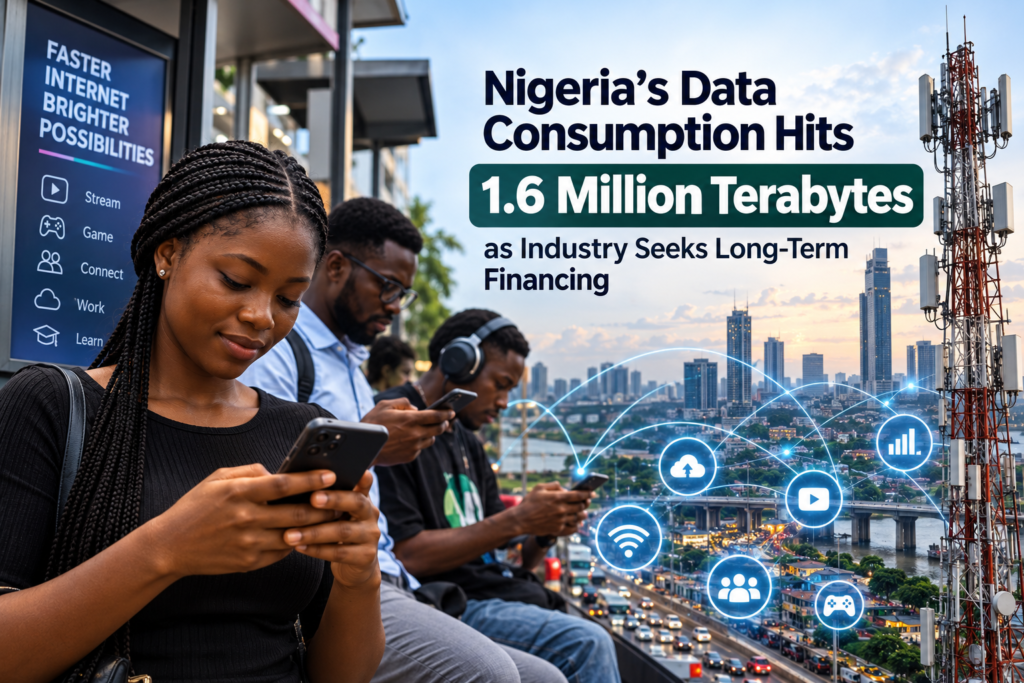
Nigerians consumed approximately 1.6 million terabytes of data in July 2026, underscoring the rapidly expanding demand for telecommunications and digital services while operators continue to face major infrastructure and financing constraints.
The figure was disclosed following the Nigeria Digital Connectivity Investment Forum 2026, organised by the Nigerian Communications Commission in collaboration with Swedfund and Ookla.
According to stakeholders at the forum, data consumption in Nigeria has increased substantially as more economic and social activities move online.
July’s consumption was approximately 47% higher than the level recorded a year earlier, demonstrating the pace at which demand for digital connectivity is expanding.
Telecommunications and information services already accounted for 9.72% of Nigeria’s real GDP in the second quarter of 2026, highlighting the sector’s growing importance to the wider economy.
Industry stakeholders expect demand to increase substantially over the coming decade.
Nigeria’s telecom subscriptions are projected to rise from approximately 195 million currently to 350 million within 10 to 15 years.
The projected increase will require significant expansion of network infrastructure, fibre-optic capacity, data centres, power systems and other digital infrastructure.
However, the industry’s ability to meet this demand is being constrained by financing and infrastructure challenges.
Participants at the forum called for greater availability of long-tenor naira financing, arguing that telecommunications infrastructure requires long repayment periods because network investments often involve significant upfront capital expenditure.
The industry also identified the cost and reliability of electricity as a major constraint.
Telecommunications companies operate thousands of network sites across the country, many of which require backup power systems because of unreliable grid supply.
Higher energy costs consequently feed directly into network operating expenses.
Right-of-way and permitting requirements were also identified as major obstacles.
Operators seeking to deploy fibre and other infrastructure frequently have to navigate multiple approval processes across federal, state and local authorities.
Stakeholders argued that reducing these barriers would accelerate network expansion and make digital infrastructure investment more attractive.
Another major issue is the development of Nigeria’s fibre backbone.
The industry is looking to the 90,000-kilometre Project BRIDGE fibre backbone to improve connectivity and reduce gaps between urban and underserved areas.
The expansion is particularly important because Nigeria’s digital divide remains significant.
While urban areas have considerably greater access to high-speed digital services, rural communities continue to face weaker coverage and limited access to reliable broadband.
The forum therefore emphasised the need for coordinated action among government, regulators, investors, financiers and telecommunications operators.
The industry’s growth also has implications beyond telecommunications.
As more Nigerians use digital financial services, e-commerce platforms, online education, cloud services and digital entertainment, improvements in connectivity can increase productivity across other sectors.
The expansion of financial inclusion provides a clear example.
Nigeria’s formal financial inclusion rate has now reached 73%, while digital financial-service usage has risen to 64.4%.
That means the telecommunications infrastructure underpinning mobile banking, digital payments and other financial services is becoming increasingly important to the country’s financial system.
The same infrastructure also supports businesses that increasingly rely on digital sales, remote services, online marketing and cloud-based systems.
Nigeria’s challenge is therefore moving beyond simply connecting more people.
The country must now build enough reliable, affordable and high-capacity digital infrastructure to support an economy in which data consumption is growing dramatically.
With consumption already at 1.6 million terabytes in a single month, the investment required to keep networks ahead of demand will become increasingly significant.