
Tinubu Seeks Senate Approval for $7.7 Billion External Loan to Finance 2026 Budget Deficit
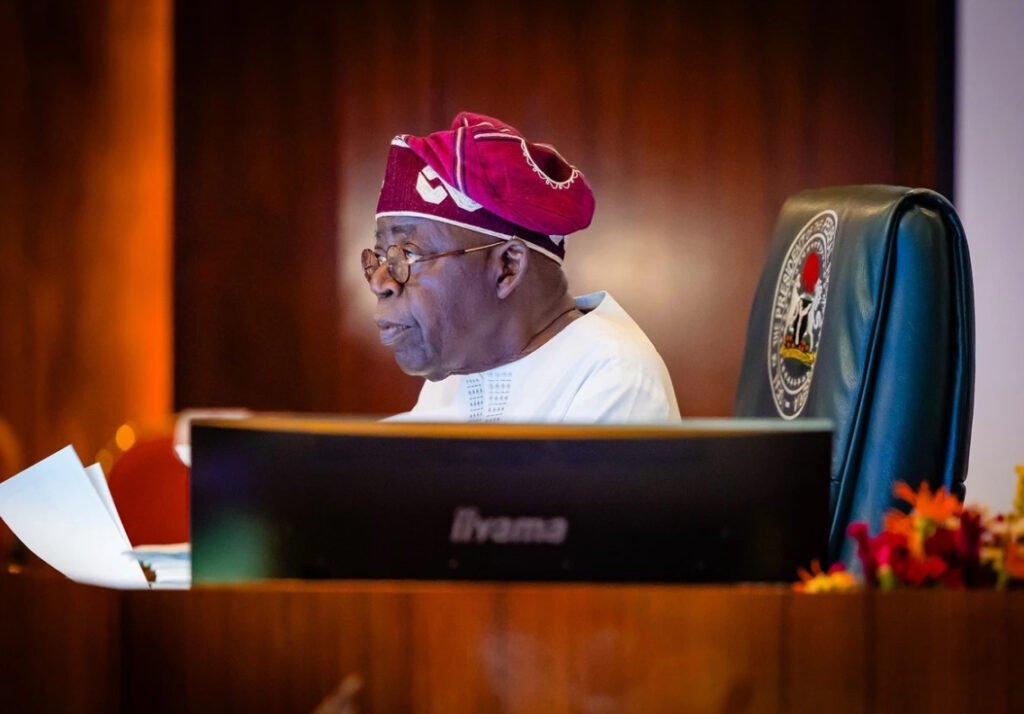
President Bola Tinubu has requested Senate approval for a fresh external borrowing plan of approximately $7.7 billion, equivalent to ₦10.79 trillion, to partly finance the Federal Government’s 2026 budget deficit.
The request was conveyed in a letter dated October 26, 2026, addressed to Senate President Godswill Akpabio and read during Wednesday’s plenary session.
According to the President, the proposed external borrowing is part of the ₦29.2 trillion in new borrowing provided for under the 2026 Appropriation Act.
The approved borrowing plan comprises ₦18.4 trillion in domestic borrowing and ₦10.79 trillion in external financing, intended to support the implementation of projects and programmes captured in the national budget.
The proposed external borrowing is equivalent to $7.707 billion, calculated using the budget exchange rate of ₦1,400 to the dollar.
Tinubu explained that the funds would be used to part-finance the budget deficit, which he put at approximately ₦20.23 trillion in the letter, while supporting priority expenditure across several sectors.
These include defence and security, transportation, agriculture, power, education and healthcare.
Government considers multiple funding options
The President said the Federal Government would explore different sources of external financing, including concessional and commercial loans from multilateral and bilateral institutions, facilities from international financial institutions, bridge financing arrangements, loan syndications and Eurobond issuance.
He indicated that greater emphasis would be placed on Eurobond issuance because of the relatively shorter time required to raise funds and the potential to secure substantial financing through international capital markets.
However, the final terms of any Eurobond issuance, including interest rates, maturity periods and other conditions, would depend on market conditions at the time of pricing.
The Federal Ministry of Finance and the Debt Management Office are expected to work together to secure favourable borrowing terms for the country.
The President also requested that the borrowing be implemented in accordance with the relevant provisions of the Debt Management Office Establishment Act, which requires legislative approval for external loan agreements and their terms.
New request replaces earlier borrowing proposal
The latest request comes shortly after the President submitted an earlier proposal seeking approval for a supplementary external borrowing plan involving $20.52 billion and €1.05 billion for the 2026–2027 period.
The new submission effectively replaces that earlier request, providing a more specific breakdown of the external financing required under the 2026 budget.
Senate President Godswill Akpabio described the latest correspondence as more explicit regarding the government’s borrowing requirements.
The request was subsequently referred to the Senate Committee on Local and Foreign Debts for further legislative consideration.
The committee is expected to examine the proposal and report back to the Senate before any final approval is granted.
Nigeria’s public debt continues to rise
The proposed borrowing comes amid an increase in Nigeria’s public debt stock.
Data from the Debt Management Office showed that the country’s total public debt rose to ₦166.79 trillion as of June 30, 2026, from ₦159.35 trillion at the end of March.
Domestic debt accounted for ₦91.59 trillion, representing approximately 54.91 per cent of the total, while external obligations made up the remaining portion.
Nigeria’s public debt has also increased considerably since the current administration assumed office in 2023. The country’s total debt stood at ₦87.38 trillion as of June 30, 2023.
The latest request therefore adds to the debate over the government’s reliance on borrowing to finance expenditure and infrastructure development.
While external borrowing can provide access to funds for projects that may support long-term economic growth, the cost of servicing such obligations remains an important consideration, particularly when repayment is denominated in foreign currencies.
The eventual impact of the proposed loan will depend on the financing terms, the productivity of the projects funded and the government’s capacity to generate sufficient revenue to meet future repayment obligations.




