Nigerians’ Personal Loans Hit N2.06tn as Consumer Credit Expands Amid Cost Pressures
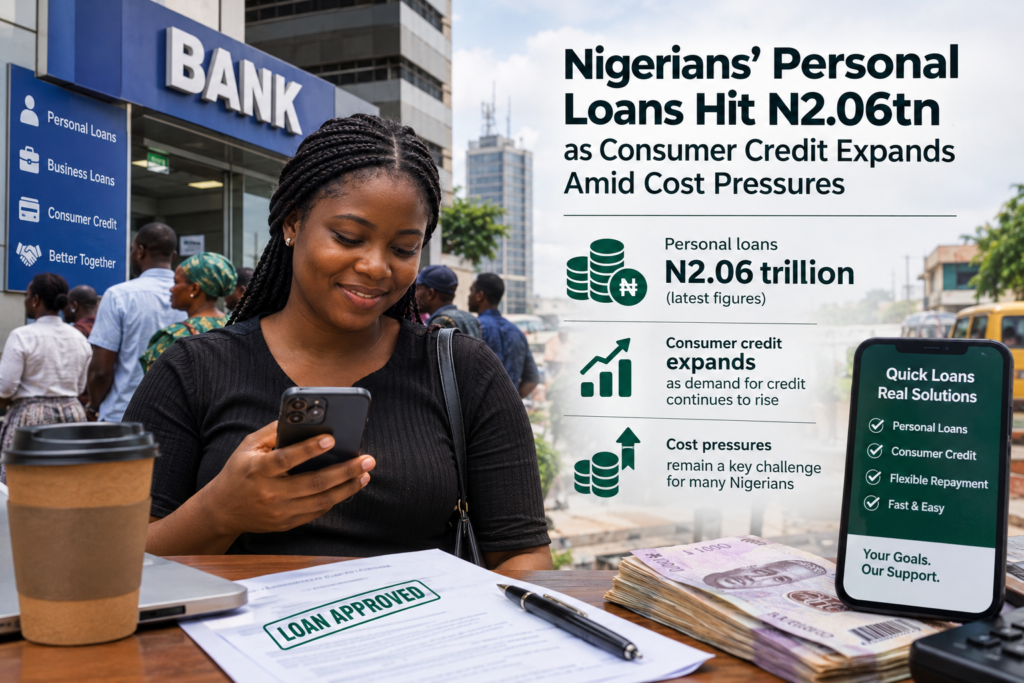
Personal loans obtained by Nigerians reached an estimated N2.06 trillion in May 2026, highlighting the increasing reliance on credit as households navigate persistent cost pressures and weak consumer spending.
The figure is contained in the Central Bank of Nigeria’s latest Economic Report and represents approximately 64.78% of the N3.18 trillion total consumer credit outstanding during the month.
The CBN data showed that overall consumer credit increased by 1.60% month-on-month, rising from N3.13 trillion in April to N3.18 trillion in May.
In absolute terms, consumers borrowed an additional approximately N50 billion within one month.
The increase was driven by both personal and retail lending.
Personal loans increased by 1.98%, while retail loans rose by 0.90% during the period.
The latest increase in personal borrowing comes against a complicated backdrop.
Although Nigeria’s inflation rate has fallen substantially from its previous highs, households continue to face elevated costs for food, housing, transportation, education and other essential goods and services.
At the same time, consumer demand remains relatively weak because household incomes have not necessarily increased at the same pace as the cost of living.
This has created a situation where some households are turning to formal credit not necessarily to finance investments or expand businesses, but to meet immediate expenditure requirements.
The trend is consistent with findings from the latest EFInA financial-inclusion survey.
The survey found that 40.8% of formal borrowers now use credit for coping and consumption, up from 31.7% in 2023.
Meanwhile, productive enterprise borrowing declined from 40.2% to 34.3%.
The change is important because consumer credit can have different implications depending on why the money is borrowed.
Credit used to acquire productive assets or expand a business can potentially increase future income.
Borrowing to cover food, rent, school fees or other recurring expenses, on the other hand, may indicate that household income is insufficient to meet current obligations.
Nigeria’s financial system is also entering a new monetary-policy environment.
The CBN cut its Monetary Policy Rate by 350 basis points to 23% at its September meeting, the first major reduction following a prolonged period of restrictive monetary policy.
The objective is partly to improve monetary-policy transmission and eventually reduce the cost of credit to businesses and households.
However, the reduction in the policy rate has not yet translated into proportionate reductions in lending rates.
The CBN’s latest Business Expectations Survey found that businesses continued to identify high interest rates as one of their three biggest constraints in September, alongside taxation and insecurity.
The high cost of borrowing means that consumers who depend on credit can still face substantial repayment obligations even as the broader interest-rate environment begins to ease.
The expansion of consumer credit therefore presents a mixed picture.
On one hand, increased formal borrowing suggests that more Nigerians are gaining access to financial services.
On the other, the increasing use of credit for coping and consumption suggests that financial access is not automatically translating into stronger household financial health.
The latest data reinforces the argument that Nigeria’s credit expansion needs to be accompanied by stronger household incomes, lower borrowing costs and increased access to productive finance.
Without those improvements, an expansion in consumer lending could simply mean that more households are borrowing to maintain their current standard of living rather than using credit to build additional income.