Multinational Exits Reshape Nigeria’s Corporate Landscape as Global Companies Scale Back Operations
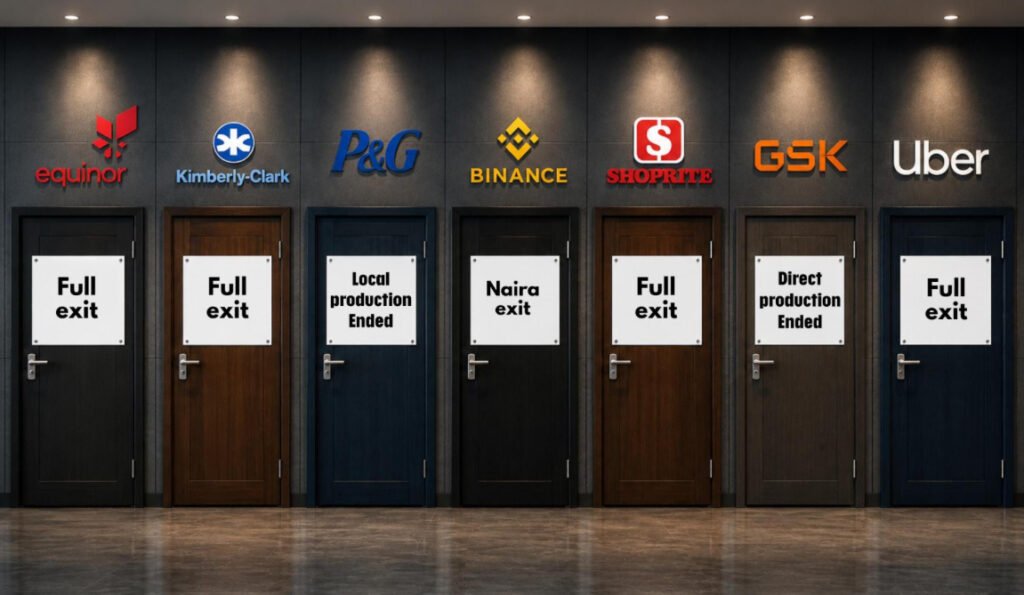
A wave of multinational exits, divestments and business restructuring has reshaped Nigeria’s corporate landscape since President Bola Tinubu assumed office in May 2023.
Several international companies have completely withdrawn from the Nigerian market, while others have ended local manufacturing, transferred distribution to third parties or sold specific businesses while retaining a limited presence in the country.
The trend has occurred against a challenging operating environment characterised by foreign exchange pressures, naira volatility, high inflation, weaker consumer purchasing power and rising business costs.
While some companies have linked their decisions directly to global strategy rather than Nigeria-specific conditions, the growing number of restructurings has intensified debate over the country’s investment climate and the impact of recent economic reforms.
Here are seven major multinational companies that have either fully exited Nigeria, ended significant local operations or substantially changed their business models since 2023.
What you should know
Not every multinational departure from Nigeria represents the same thing.
There is an important difference between:
- A full exit: The company completely sells or closes its Nigerian business.
- An exit from local manufacturing: Products remain available, but are imported rather than produced locally.
- A distribution-model change: The company stops operating directly and relies on third-party distributors.
- A business divestment: A specific Nigerian asset or business is sold while the multinational may retain other interests.
- A market exit: The company stops providing a particular service, even if its broader global platform remains accessible.
This distinction is important because describing every restructuring as a complete exit from Nigeria can give a misleading picture of the country’s multinational business environment.
1. Equinor — Full exit from Nigeria
Norwegian energy company Equinor became one of the major multinationals to completely leave Nigeria after more than three decades in the country.
Equinor, which had operated in Nigeria since 1992, announced in November 2023 that it would sell its Nigerian business to Nigerian-owned energy company Chappal Energies.
The transaction was completed on December 6, 2024, following the required approvals, transferring Equinor’s Nigerian assets to Chappal Energies.
The deal was valued at up to $1.2 billion, consisting of an initial purchase price of $710 million and additional contingent payments.
Equinor’s Nigerian portfolio included interests in OML 128 and the Agbami oil field.
The transaction marked the end of Equinor’s more than 30-year presence in Nigeria.
2. Kimberly-Clark — Full exit and closure of local manufacturing
American consumer-products manufacturer Kimberly-Clark, known for brands including Huggies and Kotex, announced in May 2024 that it would leave Nigeria after almost 15 years.
The company said it would close its manufacturing facility and commercial office in Lagos and stop manufacturing, marketing and selling its Huggies and Kotex products in the country.
Kimberly-Clark attributed the decision to changes in its global strategic priorities as well as developments in Nigeria’s economic environment.
The departure was particularly notable because it came only about two years after the company reopened a $100 million manufacturing facility in Lagos.
The episode highlights the difficulty companies can face when long-term manufacturing investments encounter major changes in market conditions.
3. Procter & Gamble — Local production discontinued
Procter & Gamble (P&G) took a different approach.
In December 2023, the consumer-goods giant announced that it would wind down its on-ground operations in Nigeria and move towards an import-only business model.
P&G owns brands such as Pampers, Always, Ariel, Oral-B and Gillette.
The company cited the difficulty of operating as a dollar-denominated business in Nigeria and the broader macroeconomic environment.
The restructuring effectively ended P&G’s local manufacturing operations, although its products continued to be available to Nigerian consumers through imports.
P&G should therefore not be described as having completely abandoned the Nigerian market. Rather, it exited local production and changed the way it serves the market.
4. Binance — Exit from the naira market
Cryptocurrency exchange Binance also withdrew from an important part of its Nigerian operations in 2024.
In March 2024, the platform discontinued its Nigerian naira services following increased regulatory scrutiny and a confrontation with Nigerian authorities.
The company stopped accepting naira deposits, ended naira withdrawals and removed naira trading pairs. Remaining naira balances were converted to USDT.
The move came amid heightened concerns from Nigerian authorities about cryptocurrency exchanges, foreign-exchange market activities and illicit financial flows.
However, Binance’s decision did not represent a complete withdrawal of the platform from Nigeria. Other Binance services and cryptocurrencies remained accessible to Nigerian users.
The case therefore represents a naira-market exit rather than a total country exit.
5. Shoprite — Franchise model eventually comes to an end
South African retailer Shoprite had already shifted away from direct ownership of its Nigerian outlets before the recent wave of corporate restructuring.
In 2021, Shoprite Holdings sold its 25 Nigerian outlets to Ketron Investment Limited, a subsidiary of Persianas Investment, effectively moving the business towards a locally operated franchise model.
However, the locally operated business subsequently faced significant challenges as operating costs increased and consumers faced declining purchasing power.
The difficulties contributed to outlet closures in cities including Ibadan and Ilorin, with the remaining stores eventually shut down.
By March 2026, the franchise had completely exited the Nigerian market, bringing an end to Shoprite’s nearly two-decade presence in the country, which began in 2005.
Shoprite is therefore another example of how a multinational can first reduce its direct exposure before eventually disappearing from the market altogether.
6. GlaxoSmithKline — Direct operations scaled back
Pharmaceutical giant GlaxoSmithKline (GSK) represents another form of restructuring.
In August 2023, the company announced that it would stop selling its pharmaceutical products directly in Nigeria and transition to a third-party distribution model.
The change affected GSK’s direct commercial operations, but its medicines and vaccines continued to reach Nigerian consumers through distribution partners.
The company cited operational challenges, including foreign-exchange difficulties and the rising cost of doing business.
GSK therefore represents a business-model exit from direct operations, rather than a complete withdrawal of its products from Nigeria.
Its continued engagement through partners means the company’s presence in the Nigerian market has not disappeared completely.
7. Uber — Full ride-hailing exit in 2026
Ride-hailing company Uber became the latest major multinational to announce its departure from Nigeria.
On September 2, 2026, Uber announced that it would cease its ride-hailing operations in Nigeria after 12 years in the country.
Uber launched in Lagos in 2014 before expanding its operations to other Nigerian cities.
The company said the decision followed a review of its business operations but did not provide a specific reason for the withdrawal.
The exit comes as Nigeria’s ride-hailing sector continues to contend with rising operating costs, fuel expenses, inflation and currency volatility.
Uber also clarified that its departure was not connected to the recent directive by the Federal Airports Authority of Nigeria (FAAN) concerning e-hailing operations at Nigerian airports.
Unlike GSK or P&G, Uber’s decision represents a much clearer country-level operational exit from its core ride-hailing business.
Why are multinational companies restructuring?
The reasons behind these decisions vary from company to company, and it would be inaccurate to attribute every departure exclusively to Nigeria’s economic policies.
However, several recurring economic pressures have made operating in Nigeria more difficult.
Foreign exchange risk
Companies that need to import raw materials, equipment or finished products can face substantial pressure when the naira depreciates sharply.
A weaker naira increases the local-currency cost of dollar-denominated obligations.
For companies with limited ability to increase prices, this can significantly squeeze margins.
Inflation and operating costs
High inflation increases the cost of wages, transportation, energy, rent, logistics, raw materials and other business inputs.
Companies must then decide whether they can pass those higher costs to consumers.
Where consumers are already under financial pressure, significant price increases can reduce demand.
Weaker consumer purchasing power
The combination of inflation and currency depreciation reduces the real purchasing power of consumers.
This is particularly important for multinational consumer-goods companies selling everyday products.
If consumers begin switching to cheaper alternatives or reducing consumption, multinational companies may reassess the economics of maintaining expensive local manufacturing and distribution structures.
Energy and logistics costs
Nigeria’s infrastructure challenges also increase the cost of doing business.
Companies operating factories, warehouses and large distribution networks often require reliable electricity, transportation and logistics.
Where these services are expensive or unreliable, businesses may need to spend more on alternative power and other operating arrangements.
Do multinational exits prove that Tinubu’s reforms are failing?
The growing number of corporate exits has been cited by some analysts as evidence of weaknesses in Nigeria’s current economic policy direction.
However, the issue is more complicated.
President Tinubu’s administration inherited significant structural problems, including foreign-exchange distortions, fiscal pressures, energy constraints and a difficult business environment.
Some of the reforms introduced since 2023 were specifically designed to correct those distortions, but reforms can also create short-term economic pain as prices and exchange rates adjust.
At the same time, companies make decisions based on their own global strategies, profitability expectations and capital-allocation priorities.
For example, a multinational may decide globally to reduce exposure to a particular market even when the local economy is not the sole reason.
Therefore, the corporate exits should be viewed as important signals about the business environment, but not as standalone proof that one particular policy caused every departure.
The bigger picture
The more important issue is not simply the number of multinationals leaving Nigeria, but what type of business activity Nigeria is losing and what replaces it.
Equinor’s exit, for example, transferred Nigerian oil assets to a Nigerian-owned company, meaning the assets remained within the country’s energy sector.
P&G’s decision ended local production but left its products available through imports.
GSK moved from direct commercial operations to third-party distribution.
Binance withdrew naira services without completely disappearing as a global platform.
Shoprite eventually left after years of operating through a local franchise structure.
Uber, meanwhile, is withdrawing its core ride-hailing operations entirely.
These examples show that Nigeria’s corporate landscape is not simply experiencing a blanket multinational exodus. Instead, companies are reassessing how much capital they commit, how they manufacture, how they distribute products and whether certain operations remain commercially viable.
The challenge for Nigeria is to ensure that the companies that remain can expand while new domestic and foreign investors replace lost investment, technology, jobs and productive capacity.
Ultimately, the success of the country’s economic reforms will be measured not only by macroeconomic indicators such as inflation, exchange rates and GDP growth, but also by whether Nigeria becomes a more attractive environment for long-term productive investment.