
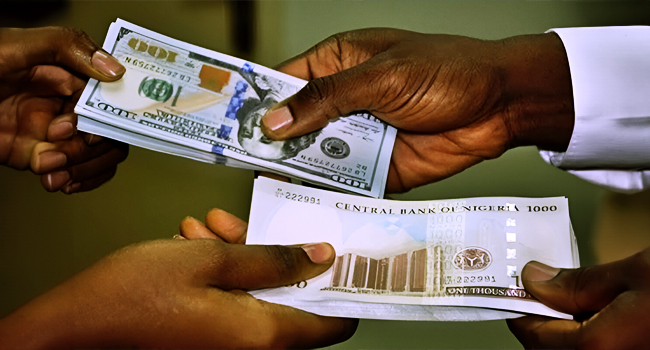
The naira weakened slightly against the United States dollar on Monday, closing at N1,375/$ in the official foreign exchange market as renewed geopolitical tensions in the Middle East fueled uncertainty across global financial markets and strengthened demand for the U.S. dollar.
According to the latest data released by the Central Bank of Nigeria (CBN), the local currency depreciated from Friday’s closing rate of N1,364/$, reflecting renewed pressure on Nigeria’s foreign exchange market amid rising concerns over global inflation, crude oil prices, and capital flows.
The decline comes as investors closely monitor the economic impact of escalating tensions in the Middle East, particularly fears that prolonged instability could sustain high global energy prices and delay expected interest rate cuts by major central banks, especially the U.S. Federal Reserve.
CBN data showed that intraday trading during the session fluctuated between N1,367/$ and N1,375/$, with the simple average exchange rate settling at N1,372.98/$.
Market activity also slowed compared to the previous trading session. Turnover in the Nigerian Foreign Exchange Market (NFEM) interbank segment stood at $51.17 million across 67 deals, down from the $78.15 million recorded across 91 deals on Friday.
Globally, crude oil prices continued to rise as concerns mounted over potential supply disruptions linked to the ongoing Middle East conflict. Brent crude futures climbed to $104.55 per barrel, while U.S. West Texas Intermediate (WTI) traded near $98.17 per barrel.
At the same time, the U.S. dollar remained relatively firm in international markets. The dollar index, which measures the strength of the greenback against six major global currencies, held steady around 97.98 as investors shifted toward safer assets amid rising geopolitical uncertainty.
The latest movement marks a reversal from the relative stability the naira experienced throughout much of April and the early part of May, when improved foreign exchange inflows and market confidence helped support the local currency.
Global financial markets remained cautious as diplomatic efforts aimed at resolving the Middle East crisis continued to face setbacks. Reports indicating that the fragile ceasefire announced earlier in April may be weakening have heightened concerns among investors over the possibility of prolonged geopolitical instability.
U.S. President Donald Trump reportedly described the ceasefire arrangement with Iran as being “on life support,” further fueling uncertainty in global commodity and financial markets.
Analysts note that while higher crude oil prices could support Nigeria’s foreign exchange earnings through improved oil export revenues, they may also worsen imported inflation and raise domestic fuel and transportation costs, creating additional pressure on the broader economy.
Investor attention is also increasingly focused on upcoming U.S. inflation data, which could shape expectations regarding future Federal Reserve policy decisions. Economists believe stronger inflation figures in the United States could delay planned interest rate cuts, potentially strengthening the dollar further and increasing pressure on emerging market currencies such as the naira.
The exchange rate movement also comes amid concerns over Nigeria’s declining external reserves. Recent figures showed that the country’s gross external reserves fell by approximately $855 million within five weeks, declining from $49.18 billion on April 1, 2026, to $48.33 billion as of May 7, 2026.
Before the foreign exchange reforms introduced under President Bola Tinubu, Nigeria operated a heavily controlled exchange rate system in which the Central Bank maintained multiple exchange windows and played a dominant role in supplying foreign currency to the market.
Despite the recent pressure on the naira, the Central Bank of Nigeria has maintained a relatively optimistic outlook regarding the country’s reserve position. The apex bank previously projected that Nigeria’s external reserves could rise to about $51 billion by the end of 2026 as part of broader macroeconomic stabilization efforts aimed at restoring investor confidence and improving market liquidity.
Analysts, however, believe the sustainability of the naira’s stability in the coming months will largely depend on external reserve strength, oil market dynamics, capital inflows, and the Central Bank’s ability to sustain confidence in the foreign exchange market amid evolving global economic risks.