The International Monetary Fund (IMF) has revised Nigeria’s economic growth forecast for 2026 downward to 4.1%, reducing its earlier projection of 4.4% by 0.3 percentage points amid mounting global and domestic economic pressures.
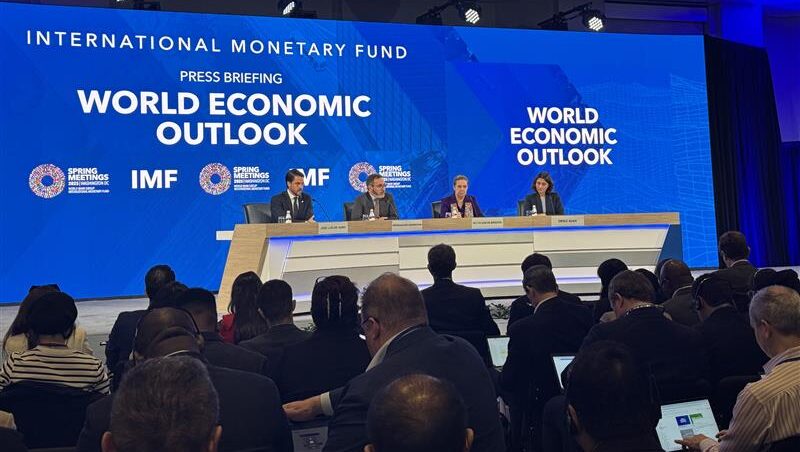
The updated outlook was disclosed during a media briefing for the launch of the April 2026 Global Financial Stability Report, monitored by Nairametrics.
Although the new projection represents a downgrade from the January 2026 forecast, it still remains slightly higher than the estimate released in October 2025.
Global shocks influencing outlook
Explaining the revision, Deniz Igan of the IMF’s Research Department said the strong economic performance recorded across Sub-Saharan Africa in 2025 has weakened due to fresh global shocks.
According to her, ongoing geopolitical tensions have disrupted global trade and commodity markets, creating difficult conditions for many economies in the region.
- “With the war, global growth has weakened, non-oil commodity prices have softened, and terms of trade have worsened for oil importers—an important source of variation across the region,” she said.
She also noted that declining foreign aid is placing additional strain on several African economies, with bilateral support estimated to have fallen by between 16% and 28% in 2025, a trend expected to continue.
Rising costs weigh on Nigeria’s economy
For Nigeria, the IMF said the downgrade reflects rising production and logistics costs, which are expected to weigh on economic activity in non-oil sectors.
Higher prices for fuel, fertilizer, and shipping services are likely to slow growth in key parts of the economy, although stronger oil prices may partially offset the impact.
- “Turning to Nigeria, we have revised growth down by 0.3 percentage points to 4.1% in 2026. This reflects a balance of two forces: higher fuel and fertilizer prices, along with increased shipping costs weighing on non-oil activity, and some offset from higher oil prices,” Igan explained.
The Fund also emphasized the importance of tight monetary policy and careful management of exchange rates and inflation expectations.
Nigeria’s inflation rate stood at around 15.06% year-on-year in February 2026, while the benchmark interest rate remains elevated at 26.50%, reflecting ongoing efforts by the Central Bank of Nigeria to stabilise prices.
The IMF expects these pressures to weigh on economic growth in 2026, with some recovery projected in 2027.
Global growth expected to slow
The IMF’s latest projections also indicate a broader slowdown in global economic growth.
According to the report, global output is expected to decline from 3.4% in 2025 to 3.1% in 2026, before improving slightly to 3.2% in 2027.
Growth across advanced economies is also projected to weaken, easing from 1.9% in 2025 to 1.8% in 2026, and further to 1.7% in 2027.
Among major economies:
- The United States is projected to grow 2.3% in 2026, remaining relatively resilient.
- The United Kingdom economy is expected to expand by 0.8%.
- Germany is projected to recover modestly from 0.2% growth in 2025 to 0.8% in 2026, rising to 1.2% in 2027.
- India is expected to record the strongest growth among major economies at 6.5% in 2026.
- Meanwhile, South Africa is projected to post one of the slowest growth rates at 1.0% in 2026.
Across Sub-Saharan Africa, economic growth is expected to slow slightly from 4.5% in 2025 to 4.3% in 2026, before rising to 4.4% in 2027.
Middle East tensions influencing markets
The IMF linked part of the downward revisions to rising geopolitical tensions in the Middle East, particularly around the Strait of Hormuz, a key global oil transit corridor.
Disruptions in the region, including attacks on oil infrastructure, have pushed energy prices higher and increased uncertainty in global markets.
These developments have also raised shipping and insurance costs, disrupted supply chains, and increased the prices of fuel and agricultural inputs such as fertilizer.
For import-dependent economies like Nigeria, these pressures are contributing to higher inflation, weaker trade conditions, and slower economic growth, factors reflected in the IMF’s latest outlook.