Eight NGX Companies Join the $5 Billion Mega-Cap Club With Combined Value of N103.12 Trillion
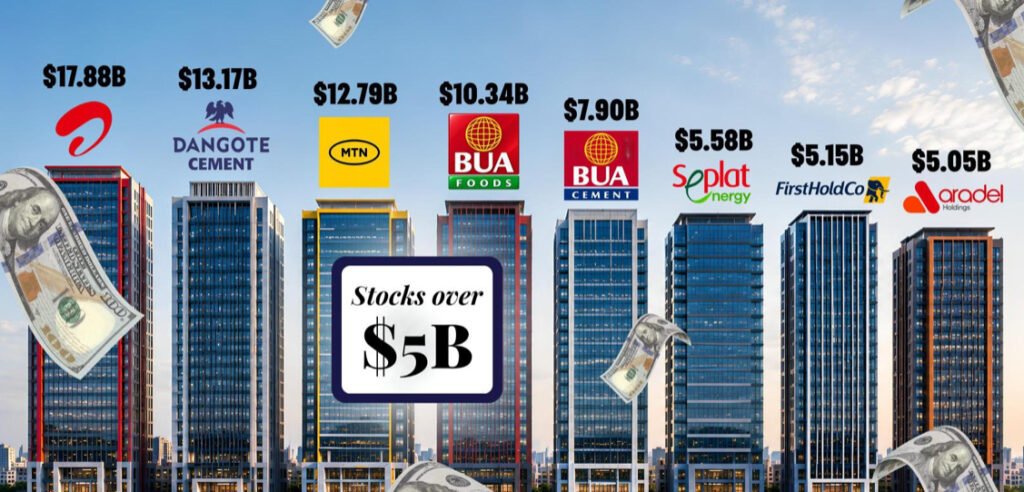
Just eight companies listed on the Nigerian Exchange (NGX) had market capitalisations of at least $5 billion as of September 2, 2026, with the group commanding a combined valuation of approximately N103.12 trillion ($77.86 billion).
The companies, described as billion-dollar mega caps, account for more than 60% of the NGX’s total market capitalisation, highlighting the extent to which a small group of large companies continues to dominate the Nigerian equities market.
The ranking is based on an analysis of the NGX daily price list as of September 2, 2026, the latest financial statements filed by the companies, and Central Bank of Nigeria exchange-rate data.
Market capitalisations were converted to US dollars using the N1,324.50/$ NAFEM exchange rate on September 2, 2026. Dollar-denominated year-to-date returns were calculated using the N1,429/$ exchange rate on January 2 and N1,324.50/$ on September 2.
The eight companies span telecommunications, industrial goods, consumer goods, oil and gas, and financial services.
What you should know
The $5 billion threshold places these companies in a distinct category on the NGX. Their combined valuation of N103.12 trillion means movements in their share prices can have an outsized effect on the overall market.
The group comprises:
- Airtel Africa — $17.88 billion
- Dangote Cement — $13.17 billion
- MTN Nigeria — $12.79 billion
- BUA Foods — $10.34 billion
- BUA Cement — $7.90 billion
- Seplat Energy — $5.58 billion
- First HoldCo — $5.15 billion
- Aradel Holdings — $5.05 billion
Together, they demonstrate the concentration of Nigeria’s listed equity market around a relatively small number of large, capital-intensive businesses.
1. Airtel Africa — $17.88 billion
Airtel Africa was the largest company on the NGX by dollar market capitalisation, valued at approximately N23.68 trillion ($17.88 billion) as of September 2.
Its share price rose 177.53% in naira terms, from N2,270 on January 2 to N6,300 on September 2.
Because the naira also appreciated against the dollar during the period, the stock delivered an even stronger 199.43% return in dollar terms.
The pan-African telecommunications company recorded revenue of N2.53 trillion in its most recent quarter ended June 30, 2026, representing a 30.95% increase from N1.93 trillion in the corresponding period.
Profit after tax rose 26.92% to N270.67 billion, while earnings per share increased from N46.48 to N60.15.
Airtel Africa’s combination of strong earnings and an exceptional share-price rally has given it a substantial valuation lead over other NGX-listed companies.
2. Dangote Cement — $13.17 billion
Dangote Cement ranked second, with a market capitalisation of approximately N17.45 trillion ($13.17 billion).
Its share price climbed 69.79% in naira terms, from N609 to N1,034, translating into an 83.18% dollar return.
The cement producer generated N2.51 trillion in H1 2026 revenue, up 21.35% from N2.07 trillion a year earlier.
Profit after tax increased 22.69% to N638.53 billion, while earnings per share rose from N30.74 to N38.22.
The combination of double-digit revenue and earnings growth has supported a significant re-rating of Dangote Cement shares during 2026.
3. MTN Nigeria — $12.79 billion
MTN Nigeria had a market capitalisation of approximately N16.94 trillion ($12.79 billion).
The stock gained 57.93% in naira terms, rising from N511 at the start of the year to N807 on September 2. Its dollar return stood at 70.39%.
Revenue increased 25.88% to N2.99 trillion in H1 2026 from N2.38 trillion.
More importantly, profit after tax increased 70.55% to N707.54 billion, significantly faster than revenue growth.
Earnings per share also climbed from N19.80 to N33.76.
This stronger growth in earnings relative to revenue indicates a substantial improvement in profitability and has been accompanied by a strong recovery in the company’s share price.
4. BUA Foods — $10.34 billion
BUA Foods ranked fourth, with a market capitalisation of approximately N13.69 trillion ($10.34 billion).
It was the only company among the eight to record a negative naira share-price return during the period.
The stock declined 4.79%, from N798.90 on January 2 to N760.60 on September 2.
However, the stronger naira changed the picture when measured in dollars. BUA Foods recorded a positive 2.72% dollar return because currency appreciation more than offset the decline in the share price.
The company’s H1 2026 revenue fell 16.15% to N765.12 billion from N912.51 billion.
Despite the weaker top line, profit after tax increased 12.38% to N292.27 billion, while earnings per share rose from N14.45 to N16.24.
The divergence between revenue and profit is important because it shows that lower sales did not translate into lower earnings during the period.
5. BUA Cement — $7.90 billion
BUA Cement had a market capitalisation of approximately N10.46 trillion ($7.90 billion).
Its share price increased 73.11% in naira terms, moving from N178.50 to N309. The stock’s dollar return was 86.77%.
Revenue rose 25.61% to N728.93 billion in H1 2026 from N580.30 billion.
Profit after tax increased by an even stronger 79.59%, reaching N324.88 billion from N180.90 billion.
Earnings per share climbed from N5.34 to N9.59.
The combination of strong revenue growth and substantially faster earnings growth has helped support the company’s major increase in market value.
6. Seplat Energy — $5.58 billion
Seplat Energy’s market capitalisation stood at approximately N7.39 trillion ($5.58 billion).
The energy company’s share price rose 112.10% in naira terms, from N5,809 to N12,320.60.
Its dollar return was even higher at 128.83%.
Seplat generated N2.50 trillion in H1 2026 revenue, up 15.48% from N2.17 trillion.
Profit after tax surged 430.30% to N225.48 billion from N42.52 billion, while earnings per share increased from N62.19 to N365.43.
The dramatic improvement in earnings has been one of the major factors supporting the company’s significant share-price appreciation.
7. First HoldCo — $5.15 billion
First HoldCo had a market capitalisation of approximately N6.82 trillion ($5.15 billion).
Its share price rose an impressive 212.94% in naira terms, from N47.90 to N149.90.
That made it the best-performing stock among the eight companies in naira terms.
Its dollar return was even stronger at 237.63%, reflecting both the share-price appreciation and naira strengthening.
First HoldCo recorded N1.93 trillion in H1 2026 revenue, up 16.66% from N1.66 trillion.
Profit after tax jumped 81.57% to N526.13 billion, while earnings per share rose from N6.84 to N11.74.
The sharp improvement in profitability has coincided with a major revaluation of the holding company’s shares.
8. Aradel Holdings — $5.05 billion
Aradel Holdings was the eighth company to cross the $5 billion threshold, with a market capitalisation of approximately N6.69 trillion ($5.05 billion).
Its share price increased 129.84% in naira terms, from N670 to N1,539.90.
In dollar terms, the stock returned 147.97% year-to-date.
Aradel recorded N2.49 trillion in H1 2026 revenue, representing a massive 576.88% increase from N368.08 billion in H1 2025.
The increase was primarily associated with the consolidation of ND Western Limited and Aradel’s majority interest in Renaissance Africa Energy Company, which significantly expanded its production base following Renaissance’s acquisition of the former SPDC onshore business.
Profit after tax increased 30.50% to N191.04 billion, while earnings per share rose from N33.26 to N35.37.
The concentration of value is significant
The combined N103.12 trillion valuation of these eight companies represents more than 60% of the entire NGX market.
That concentration has an important implication: the performance of a relatively small number of companies can materially influence the direction of the broader Nigerian equities market.
Airtel Africa alone accounts for N23.68 trillion of the group’s combined value, while Dangote Cement and MTN Nigeria add another N34.39 trillion.
This means that investors watching the NGX cannot assess market direction purely by looking at the number of stocks advancing or declining. The movement of the largest companies can have a disproportionately large effect on aggregate market capitalisation and major market indices.
The naira is also changing the investment picture
The difference between naira and dollar returns is particularly important in 2026.
A stock can rise strongly in naira terms while producing a different return for a dollar-based investor because the exchange rate changes the value of that investment when converted back into dollars.
This is visible across the eight companies.
For example, First HoldCo’s 212.94% naira return became a 237.63% dollar return, while Airtel Africa’s 177.53% naira gain became 199.43% in dollar terms.
BUA Foods provides the opposite type of example. Its share price fell 4.79% in naira terms, but the stock still generated a positive dollar return of 2.72% because of the naira’s appreciation.
For foreign investors, therefore, company performance and currency performance are both important components of total returns.
Strong earnings are supporting several of the mega caps
Another major feature of the list is that many of the companies have experienced significant earnings growth alongside their share-price appreciation.
Seplat’s profit increased more than fourfold, First HoldCo’s profit rose more than 80%, MTN Nigeria’s increased more than 70%, and BUA Cement’s rose nearly 80%.
This matters because share-price gains are generally more sustainable when they are supported by improving earnings, cash generation and business fundamentals.
However, a rising share price can also cause valuations to expand faster than earnings. Investors therefore need to consider not only how much a stock has risen but also whether future earnings can justify its current valuation.
What investors should watch
The $5 billion club is likely to remain an important area of focus for both domestic and foreign investors.
Key factors include:
- Earnings growth: Can profits continue growing quickly enough to support current valuations?
- Currency movements: Will continued naira appreciation or depreciation change dollar-based returns?
- Interest rates: Changes in fixed-income yields can influence how attractive equities appear relative to government securities.
- Sector performance: Telecommunications, cement, consumer goods, banking and energy have different growth and risk profiles.
- Liquidity: Large companies generally provide greater trading capacity for institutional investors.
- Valuation: Strong past returns do not automatically mean a stock remains attractively valued.
The bigger picture
The emergence of eight companies with market capitalisations of at least $5 billion shows how much the Nigerian equities market has expanded at the top end.
Airtel Africa’s $17.88 billion valuation places it well ahead of the rest of the group, while the inclusion of Aradel Holdings, First HoldCo and Seplat Energy shows that the $5 billion threshold now extends beyond the traditional largest industrial and telecom companies.
More importantly, the performance of these mega caps highlights the relationship between corporate earnings, investor confidence, share-price revaluation and currency movements.
For the wider NGX, the key question is whether gains in these dominant companies will continue to be supported by fundamental improvements in revenue and profitability—or whether valuations eventually begin to move ahead of underlying earnings.
For investors, the lesson is straightforward: market capitalisation shows how valuable a company is in the market, but earnings growth, cash flow, valuation and future business prospects determine whether that valuation can be sustained.