
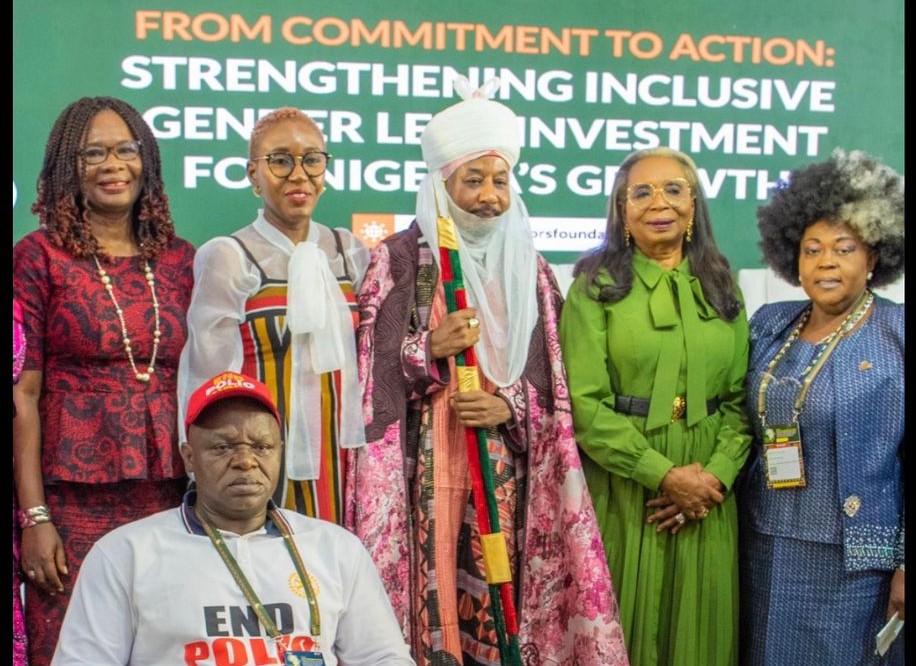
Nigeria’s pursuit of inclusive economic growth is being constrained by a widening $6.75 billion financing gap that continues to limit access to capital for women, youths, and persons living with disabilities, stakeholders warned at the 4th Gender Impact Investment Summit held in Lagos on Thursday.
The summit, themed “From Commitments to Action: Strengthening Inclusive Gender-Lensed Investment for Nigeria’s Growth,” brought together investors, development finance institutions, policymakers, and private sector stakeholders advocating stronger reforms to expand gender-focused and socially inclusive financing across the country.
The event also featured the unveiling of the Inclusive Capital Scorecard: Gender Equality and Social Inclusion (GESI) Baseline Survey by the Impact Investors Foundation (IIF).
What they are saying
Speaking during her welcome address, Chief Executive Officer of the Impact Investors Foundation, Etemore Glover, said the report showed that women, youths, and persons living with disabilities remain largely excluded from formal financing opportunities despite increasing conversations around inclusion and equitable economic growth.
▪ “We realised that if Nigeria must achieve inclusive growth, then access to finance for these categories must be addressed deliberately,” she said.
According to Glover, stakeholders had previously committed to mobilising $8 billion in inclusive capital by 2035, but only $1.25 billion has so far been deployed, leaving a financing gap of approximately $6.75 billion.
More insights
Findings from the GESI Baseline Survey revealed major structural weaknesses within Nigeria’s inclusion and impact investment ecosystem.
Although 91% of surveyed organisations claimed alignment with Gender Equality and Social Inclusion objectives, only 41% had formal GESI policies in place, highlighting what stakeholders described as a disconnect between public commitments and actual implementation.
▪ Women currently occupy only 22% of leadership positions across surveyed institutions, significantly below the 40% benchmark targeted by stakeholders.
▪ Only 5% of inclusion-focused interventions specifically target persons living with disabilities.
▪ Weak policy enforcement, poor accountability mechanisms, and limited domestic capital mobilisation were identified as key barriers slowing inclusive investment growth.
▪ Just 12% of domestic capital pools have been aggregated into inclusive investment vehicles, while only two formal GESI policies have been adopted across surveyed institutions.
Gender inclusion as an economic strategy
Vice Chair of the Global Steering Group for Impact Investment, Ibukun Awosika, said gender inclusion should no longer be treated solely as a social development issue but as a core economic growth strategy.
▪ “This is not just about the girl-child. This is about how we strategically invest in 50 per cent of our population to unlock growth for our economy and nation,” she said.
Awosika noted that women remain among Nigeria’s most underutilised economic assets, warning that inadequate access to finance and weak policy support continue to suppress national productivity and long-term economic expansion.
Former Governor of the Central Bank of Nigeria and Emir of Kano, Muhammadu Sanusi II, attributed the slow pace of progress to weak political will and male-dominated policymaking structures.
▪ “In this country, I have never seen a political cycle where gender equality was treated as a core campaign issue,” he said.
Sanusi recalled reforms introduced during his tenure at the apex bank aimed at improving female representation in the banking sector, noting that deliberate policy measures contributed to the emergence of more female bank CEOs in Nigeria.
▪ “These things do not happen by accident. They happen because policies were deliberately designed to create inclusion,” he stated.
The Emir also advocated constitutional reforms to improve women’s political representation, including reserving one senatorial seat in every state exclusively for female candidates on a rotational basis.
What you should know
The Impact Investors Foundation had previously announced plans to mobilise $8 billion in gender-inclusive capital over the next decade under its Gender Equity and Social Inclusion (GESI) Roadmap 2025–2035.
▪ The roadmap targets the creation of 40 inclusive financial products.
▪ It also aims to mobilise $1.5 billion in domestic capital pools.
▪ Stakeholders are targeting 90% adoption of GESI principles among General Partners.
▪ The framework further seeks the enactment of 20 new policy and regulatory instruments to strengthen inclusion and impact investing across Nigeria.