
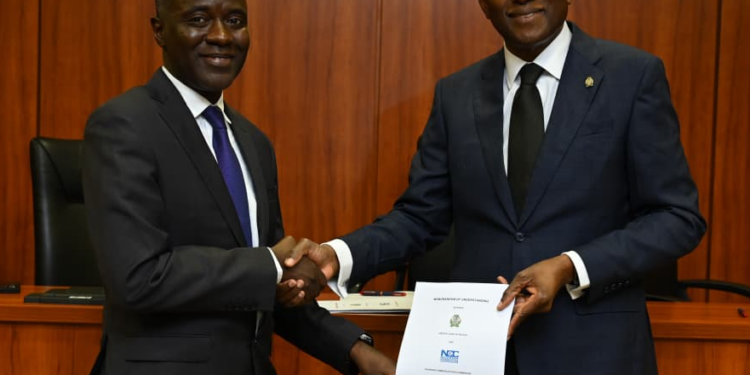
The Nigerian Communications Commission (NCC) and the Central Bank of Nigeria (CBN) have signed a Memorandum of Understanding (MoU) aimed at improving consumer protection, tackling payment fraud, and strengthening collaboration between the telecommunications and financial services sectors.
The development was announced in a statement released by Nnenna Ukoha, who confirmed that the agreement also included the launch of two joint regulatory committees.
These committees include:
- Joint Committee on Payment Systems and Consumer Protection
- Joint Committee on Telecoms Identity Risk Management System (TIRMS) Portal
The partnership is expected to improve coordination between both regulators as digital financial services continue to expand in Nigeria.
Collaboration to improve digital economy oversight
Speaking on the agreement, the Executive Vice Chairman and Chief Executive Officer of the Nigerian Communications Commission, Aminu Maida, described the MoU as a major step toward stronger regulatory cooperation.
According to him, the partnership establishes a structured framework for collaboration in key areas, including:
- Payment system integrity
- Fraud prevention and mitigation
- Consumer protection
- Digital financial inclusion
- Support for micro, small, and medium enterprises (MSMEs)
Maida said the initiative is expected to strengthen public trust, deepen financial inclusion, and promote a secure digital economy.
He also described the agreement as a milestone in Nigeria’s regulatory oversight of the digital ecosystem, reflecting a shared commitment by both institutions to financial stability and consumer protection.
Lessons from the USSD dispute resolution
The NCC chief noted that collaboration between regulators has previously delivered important results, citing the resolution of the long-running USSD debt dispute between banks and telecom operators.
According to him, the intervention restored service stability and protected the interests of consumers, telecom companies, and financial institutions.
“That intervention restored confidence, preserved service continuity, and safeguarded the interests of consumers, telecom operators, and financial institutions alike,” Maida said.
New portal to help detect telecom-related fraud risks
A major outcome of the partnership is the rollout of the Telecoms Identity Risk Management System (TIRMS) Portal, which will help financial institutions identify potential telecom-related fraud risks.
The portal aggregates data on recycled or churned phone numbers and numbers flagged within the financial sector.
This allows banks and other institutions to verify whether a phone line is:
- Active
- Recently swapped
- Disconnected due to inactivity
- Reassigned to another subscriber
- Flagged for suspicious activity
Regulators believe this capability will significantly improve fraud detection and identity verification within digital financial transactions.
CBN highlights benefits for innovation and financial stability
Also commenting on the partnership, the Governor of the Central Bank of Nigeria, Olayemi Cardoso, said the MoU would improve coordination between both institutions on approvals, technical standards, innovation trials, and regulatory sandbox testing.
He explained that the collaboration will encourage market-driven innovation while maintaining the stability of Nigeria’s financial system.
“Going forward, the Central Bank of Nigeria remains fully committed to working with the Nigerian Communications Commission to deliver a safer, more resilient, and more inclusive digital financial system,” Cardoso stated.
Previous joint initiatives between NCC and CBN
The agreement follows earlier collaborative efforts between the two regulators.
In February 2026, the Nigerian Communications Commission and the Central Bank of Nigeria proposed regular joint audits of banks, telecom operators, and other ecosystem participants.
The proposal aimed to address rising consumer complaints related to failed airtime and data purchase transactions, where bank accounts are debited without successful service delivery.
Under the framework, regulators plan to enforce clear accountability across telecom and financial service providers, establish uniform complaint resolution timelines, and strengthen consumer redress systems.
Faster refunds for failed airtime and data transactions
Earlier in January 2026, both regulators also introduced a consumer refund framework designed to guarantee subscribers refunds within 30 seconds for failed airtime and data purchases.
The system was created to address frequent cases where customers are charged for services they never receive, while also improving notification systems for erroneous or misdirected transactions.
Industry observers say the new MoU further strengthens regulatory coordination between telecom and financial authorities as Nigeria continues to expand its digital financial services ecosystem.