Aradel Holdings, Seplat Energy and Oando Build N2.86 Trillion Cash War Chest in H1 2026
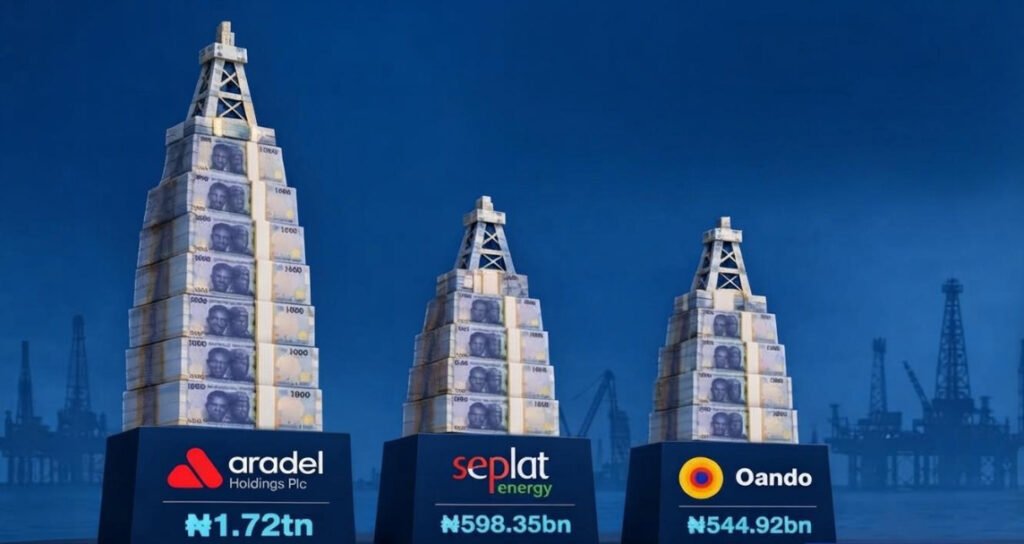
Aradel Holdings, Seplat Energy and Oando Plc ended the first half of 2026 with a combined N2.86 trillion in cash and cash equivalents, giving the three Nigerian energy companies a substantial liquidity buffer as they move deeper into the investment phase of their expanded upstream portfolios.
Financial statements show that Aradel Holdings held N1.72 trillion, Seplat Energy had N598.35 billion, while Oando Plc reported N544.92 billion in cash and cash equivalents at the end of June 2026.
Their combined cash position increased by approximately N456.34 billion during the first six months of the year.
The buildup gives the companies significant financial capacity to fund capital expenditure, develop acquired oil and gas assets, manage working-capital requirements and pursue additional growth opportunities without relying entirely on new borrowing.
What you should know
Cash and cash equivalents represent the most liquid resources available to a company. Unlike total assets or reported profits, a large cash balance gives management immediate financial flexibility.
For these three companies, the timing is particularly significant.
All three have expanded their upstream portfolios through major acquisitions and investments in recent years. The challenge after acquiring assets is not simply owning them, but investing enough capital to increase production, maintain infrastructure and improve the profitability of the acquired operations.
The combined N2.86 trillion therefore represents more than money sitting in bank accounts. It provides a financial buffer that can support the next stage of their growth strategies.
Aradel holds the largest cash position
Aradel Holdings accounted for the largest portion of the combined cash war chest, with N1.72 trillion at the end of H1 2026.
That means Aradel alone held roughly 60% of the three companies’ combined cash position.
The large liquidity position gives the company considerable room to finance its growing upstream portfolio as it integrates acquired assets and pursues higher production.
Aradel has been expanding beyond its traditional asset base, including through acquisitions that have increased its exposure to Nigerian oil and gas production.
The ability to deploy internally generated cash into these assets could reduce the company’s dependence on additional debt while allowing it to accelerate development spending where returns are attractive.
Seplat enters the second half with N598.35 billion
Seplat Energy ended the period with N598.35 billion in cash and cash equivalents.
The company’s liquidity position is important because its upstream portfolio has expanded considerably following the acquisition of additional Nigerian assets.
The integration of acquired assets requires substantial spending on production infrastructure, maintenance, drilling and field development.
A strong cash position gives Seplat the ability to finance some of this investment internally while maintaining flexibility around dividends, debt obligations and other corporate commitments.
For an upstream producer, cash generation can also be highly sensitive to oil prices and production volumes. Maintaining a significant liquidity buffer therefore provides protection against periods when operating conditions become less favourable.
Oando’s N544.92 billion reflects an active investment phase
Oando Plc recorded N544.92 billion in cash and cash equivalents at the end of June.
Its position is particularly relevant given the company’s transformation following its acquisition of the Nigerian upstream business previously owned by Eni.
The acquisition significantly expanded Oando’s upstream exposure and increased the scale of assets under its control.
However, acquiring assets is only the beginning of the investment cycle.
Oando now needs to allocate capital toward production growth, field development, infrastructure and operational improvements. Its cash position provides part of the financial foundation required to execute that strategy.
The company’s increased financing activity also suggests that it is using a combination of internal liquidity and external funding to support its expanded portfolio.
Combined cash increased by N456.34 billion
The three companies collectively added approximately N456.34 billion to their cash position during the first six months of 2026.
This is significant because the increase occurred while the companies were operating in an investment-intensive period.
The buildup suggests that operating cash generation and financing activities were strong enough to leave the companies with substantially more liquidity despite the capital requirements associated with their expanded portfolios.
However, an increase in cash should not automatically be interpreted as an increase in profitability.
Cash can rise because of operating activities, new borrowing, asset sales, equity financing or other financing transactions.
This distinction is particularly important for Oando, where financing activity played a notable role in the movement of its liquidity position.
The real opportunity is production growth
For upstream oil companies, a large cash balance becomes more valuable when it can be converted into higher production and stronger future cash flows.
Nigeria’s upstream sector has faced years of declining production, ageing infrastructure, underinvestment and operational challenges.
The emergence of larger indigenous operators with substantial financial resources could change the investment dynamics of the sector.
Aradel, Seplat and Oando now control considerably larger asset portfolios than they did previously, creating an opportunity to direct capital toward fields where additional investment can unlock production.
The key question is therefore not simply how much cash these companies hold, but how effectively they deploy it.
Acquisitions create both opportunity and pressure
Large upstream acquisitions can immediately increase a company’s asset base, but they also create significant financial and operational responsibilities.
Acquired assets may require additional investment to restore production, maintain facilities, drill new wells or improve recovery rates.
This means that cash accumulated during the first half of the year could increasingly be deployed during subsequent quarters.
If the companies successfully translate capital expenditure into higher production, their larger portfolios could generate stronger recurring cash flows over time.
If capital deployment is slower or returns are weaker than expected, however, large cash balances could remain underutilised.
Strong liquidity can reduce dependence on debt
Another important benefit of the cash buildup is financial flexibility.
Oil and gas development requires large amounts of capital, and companies can finance those investments through operating cash flow, debt, equity or combinations of these sources.
A larger internal cash position allows companies to fund a greater proportion of their investment requirements without immediately increasing leverage.
This can become particularly valuable when borrowing costs are high.
It also gives management greater flexibility to respond to acquisition opportunities or unexpected operational requirements without having to raise capital at short notice.
What investors should watch
The next stage will be less about the headline cash balances and more about how the companies deploy them.
Investors should monitor:
- Production volumes: Whether acquired and existing assets are generating higher output.
- Capital expenditure: How much cash is being committed to drilling, field development and infrastructure.
- Operating cash flow: Whether higher production translates into stronger recurring cash generation.
- Debt levels: Whether expansion is being funded increasingly through borrowing.
- Acquisition integration: How quickly newly acquired assets are incorporated into existing operations.
- Oil prices: Changes in crude prices can materially affect revenue and cash generation.
- Free cash flow: Whether companies can continue investing while maintaining healthy surplus cash.
- Shareholder returns: Whether stronger cash generation eventually supports dividends or other returns to shareholders.
The bigger picture
The combined N2.86 trillion cash position of Aradel Holdings, Seplat Energy and Oando highlights the growing financial capacity of Nigeria’s indigenous energy companies.
The significance goes beyond their individual balance sheets.
As these companies take control of larger upstream portfolios, they increasingly have the financial resources to influence production, investment and asset development across Nigeria’s oil and gas industry.
The N456.34 billion increase in combined liquidity also provides a strong starting point for the next phase of expansion.
But cash is ultimately only a means to an end.
The more important test for the second half of 2026 and beyond will be whether these companies can convert their liquidity and acquired assets into higher production, stronger cash flows and sustainable returns.
If they do, the current cash buildup could represent the financial foundation for a much larger role for indigenous operators in Nigeria’s upstream oil industry.